Eternal Record / Aerisathyn Pantheon

Enannaria

Greater Power of time, cosmic harmony, continuity, rhythm, and sacred cadence.

Seal of the Aelorian Archives
Archival Release Authorization

Released by the Aelorian Archives with ecclesiastical assent of the Aerisathyn and approved for circulation among the general populace.

Aerisathyn deity record preserved for public theological and cultural reference.

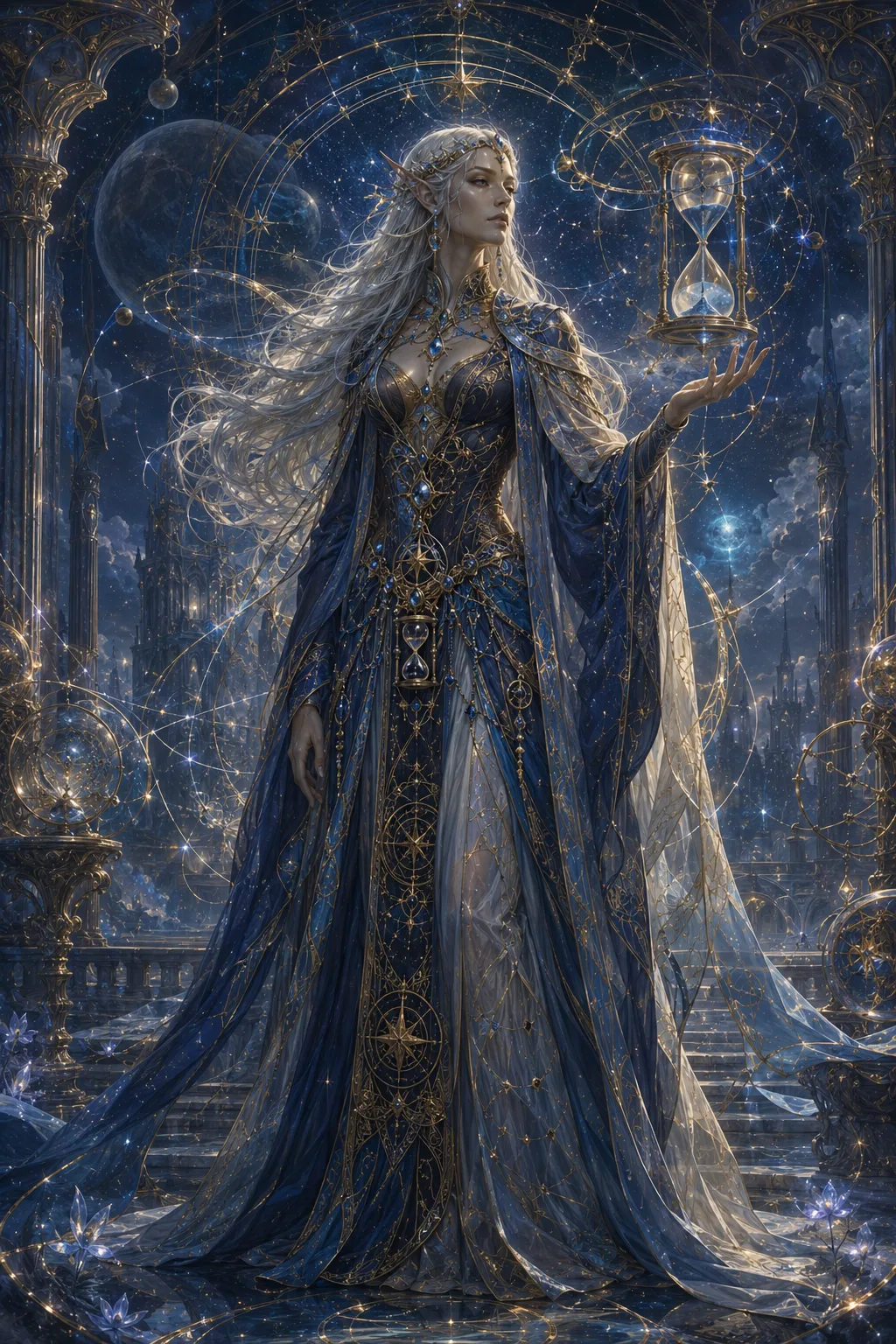
Enannaria holding an hourglass amid the stars of the Aerisathyn cosmology

Divine Dossier

Classification
Greater Power
Disposition
Lawful Neutral
Portfolio
Time, Cosmic Harmony, Continuity, Rhythm, Sacred Cadence
Worshippers
Enannaria is honored most deeply among the Syl’Aeris, particularly by those concerned with continuity across long periods, distances, disruptions, and changes of circumstance: archivists, teachers, Ithil watchers, contemplatives, diplomats, long-lived households, keepers of lineage, travelers between Khassid and Aelindor, and those responsible for preserving cultural practice without allowing it to become stagnant. Her worship is also found among individuals whose lives have been divided by exile, grief, magical displacement, memory injury, prolonged service away from their people, or other experiences that leave them uncertain whether the person who emerged remains continuous with the person who entered.
Sacred Symbol
A still pool marked by a single unbroken ripple, often enclosed within a thin ring of stars.
Common Titles
Keeper of the Eternal Flow; Weaver of Moments; The Still Pulse
Clergy Style
Enannarian clergy are contemplative, disciplined, and exceptionally attentive to pattern. Their authority rests less upon command than upon their ability to perceive continuity where others see only isolated events; they are often consulted after disruption rather than before it, particularly where a person, family, institution, or community must determine what has remained intact and what has been severed. The priesthood does not equate continuity with resistance to all change, nor does it regard change as inherently virtuous — its concern is whether movement through time preserves a coherent relation between what was, what is, and what follows.
Cleric Domains
Faith 5% • Foresight 16% • Sigil 18% • Time 39% • Vitality 22%

Percentages represent the proportion of the deity’s clergy who serve within each domain, indicating how commonly each path is practiced within the faith.

Overview

The Current Between Moments

Enannaria is among the oldest and most revered of the Aerisathyn and one of the more difficult powers of Time to describe accurately in the language normally used by Khassid’s archivists. She does not govern time primarily through measurement; seconds, dates, duration, sequence, recorded occurrence, and the placement of events within chronology fall more naturally within the expression of Time associated with Illario.

Enannaria is concerned with the continuity between moments — the passage by which one state becomes another, which she is believed to perceive directly. Her lawfulness is rooted in this continuity: Time proceeds, moments remain connected, and sequence cannot become arbitrary merely because those within it fail to perceive every transition.

Divine Record

Dogma, doctrine, worship, rites, cultural practice, signs, clergy, orders, and relations.

This record gathers the principal teachings, devotional structures, rites, signs, clerical traditions, orders, sects, and known tensions associated with Enannaria and her place among the Aerisathyn.

Archival Summary

Enannaria is among the oldest and most revered of the Aerisathyn and one of the more difficult powers of Time to describe accurately in the language normally used by Khassid’s archivists.

She does not govern time primarily through measurement. Seconds, dates, duration, sequence, recorded occurrence, historical consequence, and the placement of events within chronology fall more naturally within the expression of Time associated with Illario. Enannaria does not contest these things, nor are they absent from her awareness; they simply do not describe the aspect of Time most closely associated with her.

Enannaria is concerned with the continuity between moments. A mortal ordinarily recognizes one state and then another — a cup rests upon a table, then falls; a child speaks, then is grown; a traveler departs, then returns. History may record both conditions and the interval separating them. Enannarian thought concerns itself with the passage by which one became the other. This passage is not treated as empty distance between meaningful points; it is itself part of Time, and Enannaria is believed to perceive that current directly.

For this reason, accounts of her manifestation frequently contain apparent contradictions. Witnesses describe her standing motionless and then occupying another place without having observed her move. Syl’Aeris theologians generally reject the explanation that she has stopped time or transported herself outside it — she has moved through the observer’s time, and the observer simply failed to apprehend the continuity of her movement.

Her lawfulness is rooted in this continuity. Time proceeds. Moments remain connected. Sequence cannot become arbitrary merely because those within it fail to perceive every transition. Enannaria is therefore not a goddess of change as such; change is one consequence of temporal movement, but continuity is the law through which that movement remains coherent.

Her worship among the Syl’Aeris developed from this understanding. Passage between Aelindor and Khassid demonstrated repeatedly that movement need not mean displacement of identity — a people could cross distance, circumstance, culture, and long duration without becoming a collection of unrelated selves. The recognition of that persistent cadence became associated with Enannaria.

Dogma

You have lived every moment of your life only once, yet you have never existed in only one moment.

What you were remains joined to what you are. What you are will remain joined to what follows. You need not preserve every thought, every practice, or every wound in order for this to be true.

Do not mistake continuity for stillness.

The river remains the river because it flows. Its waters leave and other waters follow, yet the course holds them in relation. If the river were commanded never to move, it would cease to be what you intended to preserve.

So it is with you.

There will be things you must relinquish because carrying them farther would distort what they were meant to preserve. There will be things others call obsolete that you must keep because removing them would sever a connection they do not understand.

Neither age nor novelty will tell you which is which.

Attend to the rhythm. Remember where you began without demanding that you return there. Know what has shaped you without surrendering to everything that has touched you. When you cross into another place, another people, another obligation, or another portion of your life, do not ask first whether you have changed.

You have.

Ask whether what follows still belongs honestly to what came before.

Do not preserve a lie merely because it is old. Do not abandon a truth merely because the world has moved around it.

You will sometimes lose the cadence. Grief may disturb it. Fear may narrow it. Distance may make what was once familiar difficult to hear. There is no disgrace in this.

Be still long enough to recognize what continues. Then move with it.

Time does not require you to remain as you were. It requires that what you become remain truly yours.

Observed Manifestation: Appearance

Enannaria is most often portrayed according to Syl’Aeris conventions, though descriptions of her physical appearance are notably less consistent than those of many Aerisathyn powers — an inconsistency not usually attributed to competing artistic traditions, but to witnesses who often disagree about details after encountering her.

Hair length, arrangement of garments, direction of her gaze, and even the precise location in which she stood may vary between otherwise reliable accounts of the same manifestation. Such differences are generally minor; witnesses agree readily upon who they saw while disagreeing upon individual moments of the sighting.

Her appearance is typically serene, composed, and without unnecessary ornament. Garments tend toward layered forms whose boundaries appear difficult to follow closely; patterns may repeat at irregular intervals or continue across folds where the fabric should have interrupted them.

Her movements are the feature most consistently associated with divinity. Enannaria does not ordinarily blur, flash, vanish, or reappear. Observers instead discover that movement has occurred without having perceived its progression — she may raise a hand and seem to have completed the gesture before attention registers that it began, or a person who looks briefly away may find her elsewhere in the same chamber without any sense that she crossed the intervening space. Such events are not understood as failures of memory; Enannaria moves within temporal continuity in a manner that mortal perception does not divide successfully into observable moments.

Her presence is consequently more ephemeral than imposing. Time does not appear to obey her through visible alteration. Rather, those around her become aware that their ordinary experience of Time is incomplete.

Doctrine & Teaching

Enannarian theology rejects both rigid preservation and unexamined novelty. Continuity is not achieved by refusing movement; a practice maintained after its meaning has been lost may possess age without continuity. A family may repeat the words of an ancestral vow while living contrary to everything that vow once established; a community may preserve its language, ceremony, clothing, and symbols while severing the relationships those forms were intended to sustain. Such preservation is treated as an imitation of continuity rather than its fulfillment.

The reverse problem is equally serious. Necessary adaptation does not justify indiscriminate severance. A practice may become inconvenient without becoming meaningless; a person may abandon an obligation and call the act growth when it represents only escape from responsibility. A displaced community may adapt successfully to its surroundings while gradually ceasing to understand what its inherited customs were meant to carry forward.

Enannarian clergy therefore resist simple judgments based upon whether something is old or new. Their concern is relation: a later state must be understood in meaningful connection with what preceded it.

This doctrine has particular importance among the Syl’Aeris because of their relationship with Aelindor and Khassid. Life within the Archipelago inevitably introduces Human institutions, Crown calendars, maritime customs, neighboring peoples, mixed settlements, trade practices, new relationships, and circumstances unknown to earlier generations. Enannaria does not instruct the Syl’Aeris to resist these influences merely because they are foreign; she requires that incorporation occur without unconscious severance.

The same principle governs individual life. A person altered by grief, war, parenthood, exile, injury, age, or long service need not recover some previous version of themselves in order to remain whole. Enannarian counsel instead asks whether the present person can recognize the path connecting who they were to who they have become. Where that path has been severed, restoration begins by identifying the break.

Worship & Devotional Structure

Enannarian worship is generally quiet and frequently mistaken by outsiders for private contemplation. Still water appears throughout her practice because it demonstrates continuity without obvious motion; pools, basins, sheltered coves, slow rivers, and reflective vessels are therefore common features of her shrines.

Enannaria’s Pool in Aelindor remains the most important expression of this symbolism. It is not approached primarily for blessing, divination, or absolution; those who come before it seek recognition of whether what has endured within them remains aligned.

Her temples within Khassid are often integrated into Syl’Aeris enclaves, archive chambers, old groves, teacher-lineages, Ithil watches, and households that have maintained long connections with Aelindor.

Formal services tend to emphasize cadence rather than proclamation. Repeated movements, measured intervals of silence, recitation separated by deliberate pauses, recurring musical phrases, and the marking of temporal transitions may all serve devotional purposes.

Her faithful frequently maintain two systems of time without considering them contradictory. A Syl’Aeris may use Crown dating for civic or legal purposes while maintaining Enannarian cadence marks privately to preserve significant intervals that official calendars do not express — the duration between departure and return, the interval between injury and restored function, the period during which a family ceased one observance and established another, or the recurrence of an event across generations.

Rites & Observances

The Still-Water Vigil

The supplicant sits before undisturbed water and considers a period of significant change or disruption. The rite does not require visions; its purpose is to identify the continuous thread joining the person before the event to the person who now examines it.

The Unbroken Ripple

Used when a household, order, or community undergoes a major transition. A single disturbance is made upon still water and those present watch the resulting motion until the surface settles again, emphasizing that movement may alter every point upon the surface while remaining part of one continuous event.

The Cadence Reckoning

A cleric reconstructs not merely what occurred, but the intervals and recurring patterns through which events developed. It is frequently used after institutional failure, repeated disputes, recurring magical incidents, or generational harm.

The Threshold Watch

Performed during significant crossings: departure from Aelindor, long journeys, entry into extended service abroad, assumption of office, marriage into another people, or other transitions likely to alter daily identity. The rite establishes what the participant intends to carry forward rather than what they intend never to change.

The Oath of Unbroken Self

A personal observance used after severe disruption. It does not promise to return the participant to who they once were; instead, it affirms that what follows will remain honestly connected to what came before.

Cultural Praxis

Enannarian practice has particular force among Syl’Aeris communities living permanently or semi-permanently within the Morgdhavian Archipelago. Their circumstances require adaptation: Human civic structures, Crown law, maritime life, commerce, mixed settlements, unfamiliar dangers, and extended separation from Aelindor all produce forms of cultural movement that cannot be answered simply through refusal.

Enannarian households commonly preserve small practices whose significance may be invisible to neighboring peoples. Cadence marks appear in private margins. Certain meals recur according to intervals unrelated to Crown calendars. A household may preserve the position of an old object after every relocation, not because the object itself is sacred but because its placement maintains an identifiable continuity between homes.

Teachers frequently use Enannarian methods when introducing Syl’Aeris children raised primarily in Khassid to older cultural practices. The purpose is not to produce exact replicas of Aelindorian life, but to ensure that inherited forms remain connected to the principles they originally expressed.

The tradition also affects approaches to personal identity. Long life does not guarantee continuity — indeed, Enannarian scholars often regard longevity as increasing the difficulty. A Syl’Aeris who has lived through centuries of accumulated experience may preserve abundant memory while losing any meaningful relationship between those memories and the self who presently carries them.

Memory alone is therefore insufficient; it may become chain or mist. Continuity requires that memory remain in meaningful relation to present identity.

Signs & Omens

Enannarian signs are usually expressed through repetition, temporal incongruity, or unexpected continuity. A ripple may cross still water without visible disturbance. A phrase may recur in unrelated conversations at the same interval. A person may arrive somewhere at precisely the same point in a recurring sequence despite changing the route or departure time. Old music may reproduce a forgotten cadence even when performed by someone who never learned the original form.

Some omens consist of recognition rather than supernatural display. A priest may suddenly perceive that three apparently unrelated events occupy the same place within three separate cycles. An archivist may notice that records separated by centuries contain identical intervals between cause and consequence.

Dreams associated with Enannaria are often repetitive and exact, recurring without alteration until the dreamer recognizes the pattern itself as significant.

Her clergy caution against assuming that recurrence proves destiny. A pattern is not necessarily a command to repeat it; recognition permits response before cadence becomes consequence.

Relics, Sites & Anchored Presence

Enannaria’s Pool remains the most important known sacred site associated with the goddess. Its significance lies not in miraculous transformation but in its capacity to reveal continuity without imposing it. Those who approach the Pool after prolonged absence, disruption, or uncertainty may leave with no outward sign of divine intervention, yet with a clearer understanding of what within them has remained aligned and what has not.

River stones carried between Aelindor and Khassid are common lesser sacred objects. Their significance comes from passage rather than material rarity; stones that have crossed repeatedly between the two realms may remain within families or priestly lineages for generations.

Cadence records may also acquire relic status when maintained through sufficiently long periods. These are not conventional histories — they preserve intervals, recurrences, pauses, transitions, and patterns that ordinary chronological records may neglect.

Some Enannarian sanctuaries preserve objects deliberately altered across generations. A staff may be repaired repeatedly without concealing the repairs. A ceremonial garment may contain sections woven centuries apart. Such objects are valued because they demonstrate continuity without pretending to have remained untouched.

Clergy & Agents

Enannarian clergy serve as keepers of continuity, contemplative teachers, cadence archivists, threshold witnesses, counselors after displacement, guardians of long vows, and observers of recurring patterns. Their priesthood has no interest in producing uniform lives; authority comes from the ability to distinguish coherent continuation from habit, nostalgia, evasion, or severance.

Training requires patience. A novice is expected to study ordinary chronology, recordkeeping, lineage, ritual form, and historical consequence, but these disciplines are treated as foundations rather than final expertise. Clergy are trained to examine the connections between recorded events: what persisted, what repeated, what was lost, what returned, and which transitions altered the meaning of what followed.

Senior clergy are often those capable of holding very long patterns in mind without reducing them to convenient lessons. They are also expected to resist premature interpretation — repetition may indicate continuity, unresolved harm, deliberate practice, natural cycle, or coincidence, and a priest who decides what a pattern means before understanding its cadence is considered unreliable.

The priesthood is especially valued after prolonged disruption. Communities recovering from war, displacement, magical fracture, cultural assimilation, or extended isolation may seek Enannarian counsel not to restore what existed before, but to determine what must remain connected to it.

Orders & Sects

Enannarian orders tend to distinguish themselves through the scale of continuity they study. Some are concerned principally with individual identity, memory, grief, and the maintenance of coherent selfhood across long lives. Others preserve household, lineage, and teacher traditions, examining how inherited practices can remain intact without becoming rigid imitations of earlier forms.

Certain archive-centered orders maintain cadence records alongside conventional histories; their work has occasionally proven valuable in recognizing repeating civic, magical, or social conditions before those repetitions become obvious to secular authorities. Threshold orders serve communities with frequent passage between Khassid and Aelindor, specializing in the strains created by repeated crossings, long absence, cultural adaptation, and return.

Disagreements within the faith rarely concern whether continuity matters; they concern how much alteration continuity can sustain before the relation between earlier and later states becomes false. There is no accepted universal measure.

The absence of such a measure is not considered contrary to Enannaria’s lawfulness. Law provides continuity; judgment identifies its expression.

Relationships & Tensions

Illario occupies the closest and most delicate theological relationship to Enannaria. Both are genuine powers of Time, and neither is regarded as a lesser or mistaken expression of the other. Illario apprehends Time through record, chronology, duration, consequence, lineage, and the truth of what has occurred — his relationship to Time is concrete enough that he may impose himself upon its structure. Enannaria apprehends the continuity through which one moment becomes another. Where Illario recognizes the position and measure of moments, Enannaria moves with the current connecting them. Their priesthoods therefore cooperate readily while approaching temporal questions from substantially different directions; an Illarian may determine when a sequence began and how long it endured, while an Enannarian may recognize what persisted through it and where its cadence changed.

Z’hani shares a more limited but productive intersection with her through prophecy and recurrence. His sight may reveal a possible future, while Enannarian attention may recognize that the conditions producing that future have occurred before. Dreams shared between their traditions are sometimes rhythm-warnings rather than prophecies in the strict sense: indications that an old pattern has begun to form again. Their cooperation is particularly valuable where inherited harm, repeated decisions, or recurring magical circumstances make the recognition of pattern as important as knowledge of possible outcome.

Within the Aerisathyn, Enannaria’s concern with cosmic harmony naturally places her alongside powers whose portfolios preserve coherent relations between spirit, memory, life, place, and identity. Yet her law remains distinct: she does not preserve harmony by making all things alike or by preventing necessary movement. Her attention falls upon whether each part continues in proper relation through time.

Her strongest theological tensions are therefore rarely personal rivalries. They arise around forces that create true temporal severance: attempts to remove events from consequence, destroy the meaningful connection between past and present, falsify continuity, or impose discontinuity while pretending nothing has been lost. Enannaria does not demand that Time remain unchanged — she regards the demand itself as incoherent. What she safeguards is that one moment remains truly joined to the next.