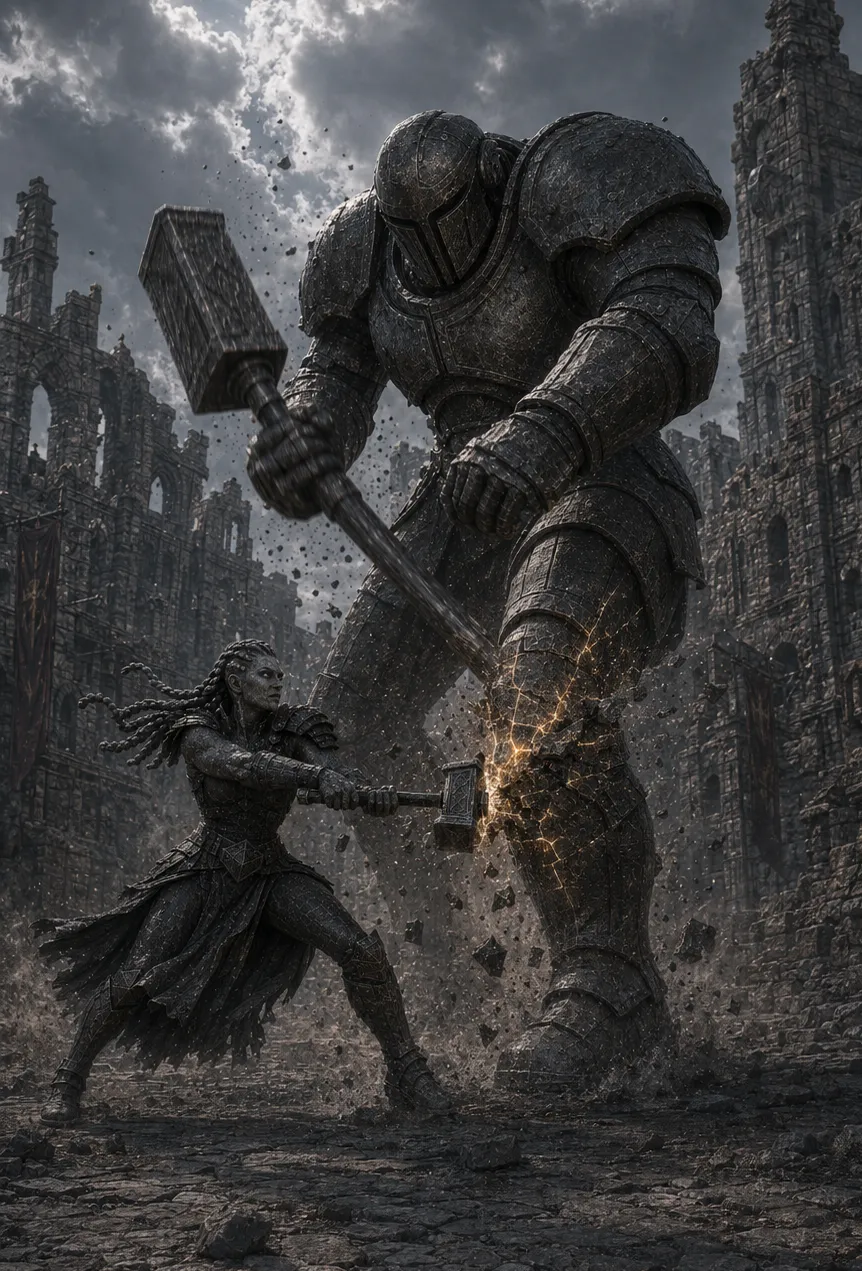
Faultseeker

Anything built can be unmade. Faultseekers enter battle with a craftsperson’s eye. Where another warrior sees armor, posture, and formation, the Faultseeker sees stress lines: the shield held a fraction too high, the stance bearing too much weight, the single soldier upon whom an entire line depends.

Seal of the Aelorian Archives
Archival Release Authorization

Approved for circulation among the general populace by order of the Aelorian Archives.

Fighter Archetype record preserved for public orientation. Complete mechanical instruction remains reserved for official release material.

Archive depiction of Faultseeker
Faultseeker field depiction from the Aelorian Archives.

Vocation Dossier

Classification
Fighter Archetype
Martial Archetype
Faultseeker
Karnathi-Exclusive Access
Karnathi exclusive tradition
Primary Principle
Identifying the load-bearing weakness in a foe, formation, or defense and applying precise force until the whole structure fails
Associated Themes
Precision, structural insight, battlefield control, pressure, disruption, collapse, restraint, and Karnathi discipline

Karnathi Exclusive: This martial tradition is culturally and institutionally restricted to Karnathi practitioners. Rules text, numerical values, and complete playable mechanics are intentionally withheld from the public archive record.

Overview

Anything built can be unmade.

Faultseekers enter battle with a craftsperson’s eye. Where another warrior sees armor, posture, and formation, the Faultseeker sees stress lines: the shield held a fraction too high, the stance bearing too much weight, the single soldier upon whom an entire line depends.

Their art is not founded upon brute strength. It is refined judgment applied at the precise point where force becomes consequence. A Faultseeker does not merely strike an enemy; they disturb the structure that allows the enemy to remain standing.

Subclass Record

Doctrine, progression, training, reputation, and signs.

This public record preserves Faultseeker as a recognized Fighter Archetype within the Hall of Vocations.

Doctrine

“I do not strike to kill. I strike to collapse. The body, the stance, the will—all have a fracture. I find it.”

— Kevran Thal, Faultseeker of the Shattered Line

Faultseekers study combat as an arrangement of weight, motion, confidence, and dependence. Every defense rests upon something. Every formation assumes that certain pieces will hold. Their discipline begins by discovering which assumption is false.

Among the Karnathi, this practice reflects an older cultural understanding: fracture is not always sudden, and strength is not the absence of weakness. Stone, bone, iron, and resolve all announce where they will fail to those patient enough to read them.

The Shattered Line

A battlefield is rarely broken everywhere at once. One step is displaced, one defender loses balance, and one opening becomes several. Faultseekers are trained to create that first failure and recognize the cascade before anyone else understands what has begun.

Their most accomplished practitioners can dismantle a superior position without appearing hurried. By the time the enemy recognizes the pattern, the point that held everything together is already gone.

Pressure and Collapse

The tradition distinguishes damage from collapse. Damage wounds a part. Collapse changes how the whole may function. Faultseekers therefore value disruption, displacement, broken rhythm, and compromised defense as highly as the killing blow.

This makes them especially dangerous to disciplined foes. The more an enemy depends upon formation, repeated motion, or a supposedly unassailable defense, the more material the Faultseeker has to work with.

The Discipline of Restraint

Seeing weakness creates an obligation to choose carefully where force is applied. Karnathi teachers warn that a student concerned only with proving that something can be broken has learned observation without judgment.

A true Faultseeker uses collapse deliberately: to end a charge, open an escape, halt a larger threat, or conclude a battle before wasteful slaughter becomes inevitable.

Feature Progression

The public archive preserves these names and their recognized order only. Complete rules text remains reserved for official release material.

Class LevelFeature
3rdStructural Insight, Break the Line
7thPressure Point
10thShatter Rhythm
15thCollapse the Foundation
18thTotal Deconstruction
Training and Calling

Training joins martial drills with the study of masonry, anatomy, armor, movement, and formation. Students learn to recognize balance before they are permitted to disturb it. Many spend as much time watching structures bear weight as they do striking practice targets.

The calling is strongest among Karnathi who possess patience, spatial judgment, and the temperament to wait for the correct failure rather than manufacture a reckless one.

Reputation

Soldiers respect Faultseekers and dislike being evaluated by them. Their quiet attention can feel uncomfortably similar to being measured for collapse.

Commanders value them as line-breakers, duelists, and answers to heavily defended threats. Engineers and masons tend to understand them more readily than warriors who equate victory with force alone.

Signs and Presentation

A Faultseeker’s attention often settles upon joints, footing, shield angles, damaged stone, and the spacing between companions. Their movements are economical, and their attacks may appear modest until the larger consequence becomes visible.

Fracture-line motifs, measured marks, stone or metal training pieces, and equipment repaired to display rather than conceal former breaks are common elements of presentation.

Chronicler’s Note

“Those who call the Faultseeker destructive have usually mistaken collapse for ruin. Ruin is waste. The Faultseeker removes one necessary thing and permits consequence to perform the remaining labor.”

— Aleryn Duskwhisper, Keeper of the Aelorian Archives

Additional field reports, regional traditions, named practitioners, and archival commentary may be appended as the record expands.