Deeds & Destinies / Hall of Legends

Caglastro

Royal Archmage of the Morgdhavian Archipelago, advisor to the Azure Crown, and final authority in matters of extraordinary arcane consequence.

Seal of the Aelorian Archives
Archival Release Protocol

Released by the Aelorian Archives with the assent of Caglastro, Royal Archmage of the Morgdhavian Archipelago, and approved for circulation among the general populace.

Legend record authenticated for public historical, royal, and arcane reference.

Warning of Restricted Knowledge

Certain matters have been omitted from this record by my direction. Those inclined to investigate further should tender all inquiries to me directly.

This route is easier and causes less collateral damage.

— Caglastro, Royal Archmage of the Morgdhavian Archipelago

Caglastro, Royal Archmage of the Morgdhavian Archipelago
Caglastro, Royal Archmage and advisor to the Azure Crown.

Legend Dossier

Name
Caglastro
Titles & Aliases
Royal Archmage of the Morgdhavian Archipelago; Confidant and Advisor to the Royal House of Lynaldi; Master of Royal Spellcraft; Final Crown Authority in Matters of Extraordinary Arcane Consequence
Classification
Living Legend
Species/Origin
Human
Born
Unknown
Affiliation
The Azure Crown
Known Apprentice
Prince Caeloryn Montesso Arcanaenix Lynaldi
Current Activity
Year 419 Post-Cataclysm

No family name, inherited title, confirmed birthplace, or date of birth appears in the public record. The Crown has never confirmed the oldest accounts of his service. It has also never formally denied them.

Overview

Royal Archmage of the Morgdhavian Archipelago

Caglastro is the most powerful publicly acknowledged archmage presently active in Khassid and one of the least fully documented figures within the modern historical record.

He serves the Royal House of Lynaldi as advisor, confidant, investigator, and guardian against arcane consequences that ordinary scholarship, law, or political authority cannot adequately address. Although he is often described simply as the Crown’s greatest wizard, the description is incomplete. His office is not primarily defined by the magnitude of magic he can wield, but by the authority entrusted to him when magical power threatens to exceed the understanding, institutions, or intentions of those attempting to control it.

Caglastro is consulted on ancient workings, forbidden or unstable research, relics whose properties resist classification, failures of containment, threats to royal wards, and discoveries whose political consequences cannot be separated from their magical nature. His counsel may determine whether an artifact is studied, sealed, destroyed, or removed from public record; whether a line of research is permitted to continue; whether a magical site may be entered; or whether knowledge already recovered must be withheld because its circulation presents a greater danger than its loss.

Biography

Arcane power, historical continuity, and the burden of preventing discovery from becoming catastrophe.

This record preserves the public account of Caglastro’s office, institutional authority, relationship with the Crown, disputed history, and influence upon the magical development of the Morgdhavian Archipelago.

Dossier Notes

Name

Caglastro

Titles & Aliases

Royal Archmage of the Morgdhavian Archipelago; Confidant and Advisor to the Royal House of Lynaldi; Master of Royal Spellcraft; Final Crown Authority in Matters of Extraordinary Arcane Consequence

No family name, inherited title, or confirmed name of origin appears in the public record. Whether Caglastro is the name given to him at birth, one adopted later in life, or a professional designation that has gradually displaced his personal identity has never been established.

Classification

Living Legend

Species/Origin

Human

His birthplace, parentage, early education, and nation of origin remain unconfirmed. Although numerous traditions claim him as a native of the Morgdhavian Archipelago, no surviving record establishes that he was born within the Isles.

Born

Unknown

Caglastro’s date of birth is not preserved in any publicly accessible registry. Persistent court traditions place him in royal service far earlier than an ordinary human lifespan should permit, with the oldest accounts claiming that he advised the first King of the united Archipelago.

The Crown has never confirmed this claim. It has also never formally denied it.

Affiliation

The Azure Crown

Caglastro serves the Crown directly and maintains a consultative relationship with the Crown Arcanum Authority. He does not administer that institution, hold command over its ordinary officers, or supervise its daily regulatory responsibilities.

Known Apprentice

Prince Caeloryn Montesso Arcanaenix Lynaldi

His acceptance of Prince Caeloryn as a personal apprentice marks a notable departure from his long-established reluctance to train students directly.

Current Activity

Year 419 Post-Cataclysm

Caglastro continues to serve as Royal Archmage of the Morgdhavian Archipelago, confidential advisor to Queen Vaelandrytha Lynaldi and the wider royal household, and final consultant in matters whose arcane consequences exceed the classifications or authority of ordinary Crown institutions.

His public appearances remain infrequent. His involvement in any matter is generally interpreted as evidence that its risks are broader, older, or less containable than official summaries initially suggest.

Overview, Authority, and Arcane Discipline

Royal Archmage of the Morgdhavian Archipelago

Caglastro is the most powerful publicly acknowledged archmage presently active in Khassid and one of the least fully documented figures within the modern historical record.

He serves the Royal House of Lynaldi as advisor, confidant, investigator, and guardian against arcane consequences that ordinary scholarship, law, or political authority cannot adequately address. Although he is often described simply as the Crown’s greatest wizard, the description is incomplete. His office is not primarily defined by the magnitude of magic he can wield, but by the authority entrusted to him when magical power threatens to exceed the understanding, institutions, or intentions of those attempting to control it.

Caglastro is consulted on ancient workings, forbidden or unstable research, relics whose properties resist classification, failures of containment, threats to royal wards, and discoveries whose political consequences cannot be separated from their magical nature. His counsel may determine whether an artifact is studied, sealed, destroyed, or removed from public record; whether a line of research is permitted to continue; whether a magical site may be entered; or whether knowledge already recovered must be withheld because its circulation presents a greater danger than its loss.

This has led some scholars to characterize him as an enemy of unrestricted inquiry. The surviving record does not support so simple a judgment. Caglastro has repeatedly encouraged research, corrected institutional misunderstandings, and preserved knowledge that others would have destroyed out of fear. His objections arise not from hostility toward discovery, but from a conviction that the ability to uncover, reproduce, or perform a thing does not establish the wisdom of doing so.

Where lesser authorities ask whether magic is possible, lawful, or useful, Caglastro is expected to ask what consequences will remain once the immediate purpose has been fulfilled.

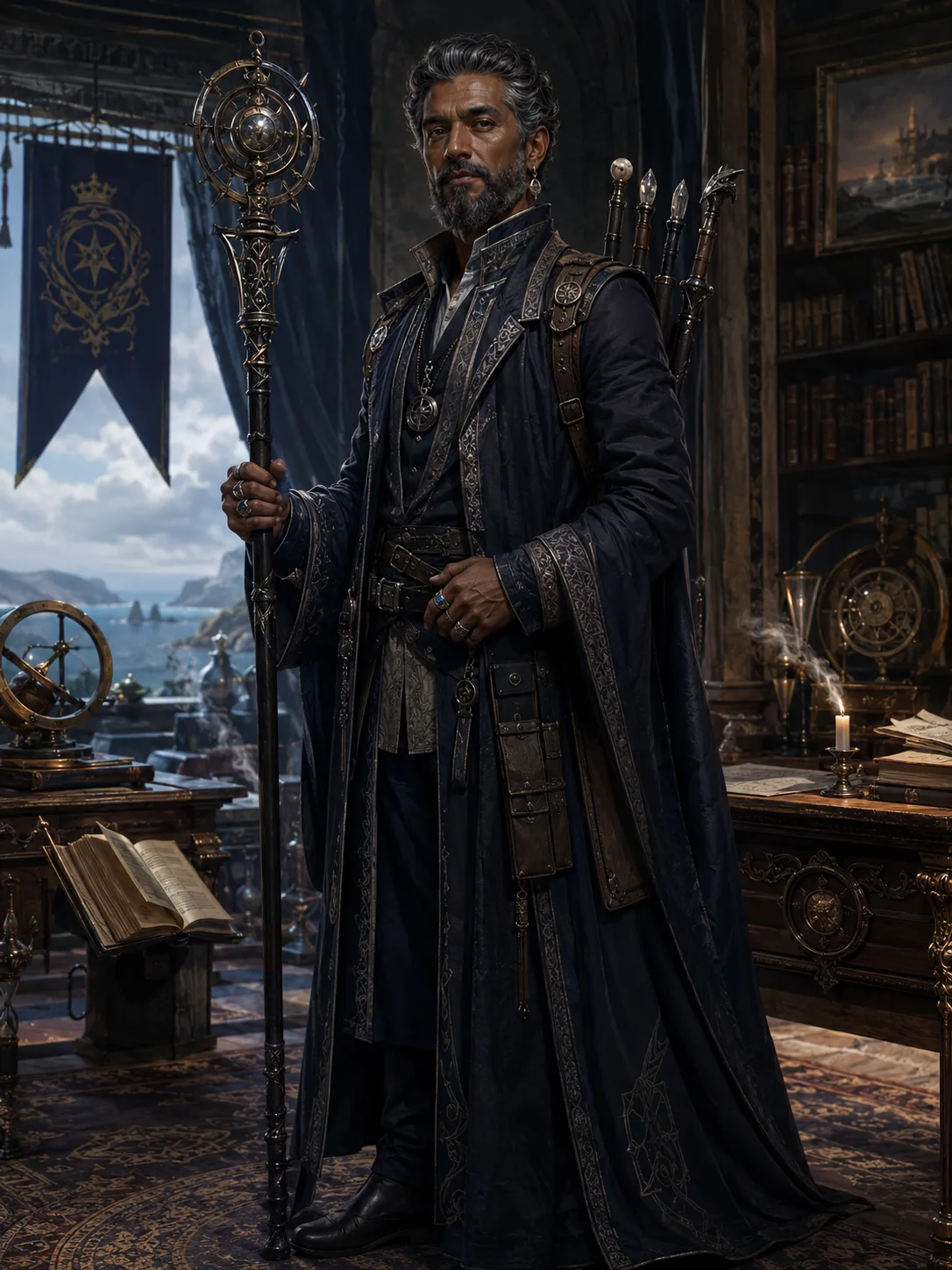
His physical appearance is publicly known to be human, yet descriptions of him remain inconsistent. Witnesses disagree about his apparent age, the color of his eyes, the precise quality of his voice, and whether he carries a staff or other arcane focus. These disagreements are especially notable because many of the witnesses involved are trained officials, court scholars, senior arcanists, or members of the royal household whose powers of observation are not ordinarily in doubt.

Most accounts nevertheless agree that Caglastro presents himself without ostentation. His authority does not rely upon ceremonial display, elaborate declarations, or visible demonstrations of power. Those meeting him commonly report an impression of profound attention, as though they have been examined not only for what they are, but for the consequences of what they might become.

Authority

Caglastro advises the Crown in matters involving magical defense, restricted knowledge, dangerous experimentation, ancient arcana, containment, and threats whose effects may cross institutional, geographic, or temporal boundaries.

His recommendations do not automatically possess the force of statute. In practice, however, they carry exceptional weight. Crown officers and institutional authorities who choose to disregard his findings are expected to provide a formal justification, preserve that justification within the record, and accept responsibility for the consequences.

The Archives contain no publicly available example in which such disagreement ultimately proved well founded.

Arcane Discipline

Caglastro is recognized as a master of Chronomastery, an advanced arcane discipline concerned with time as structure, sequence, consequence, and force.

The precise methods, capacities, and limitations of Chronomastery remain outside the public record. No official publication establishes whether Caglastro can move through time, observe events beyond ordinary perception, preserve moments, or alter temporal sequence. What is confirmed is that he possesses knowledge and recollection that cannot always be explained through surviving documents, testimony, or ordinary longevity.

Biography

Arcane power, historical continuity, and the burden of preventing discovery from becoming catastrophe.

This record preserves the public account of Caglastro’s office, institutional authority, relationship with the Crown, known associations, disputed history, and influence upon the magical development of the Morgdhavian Archipelago.
Historical Placement

Caglastro’s early history remains one of the most persistent uncertainties in the modern Crown record.

No confirmed document identifies his birthplace, family, childhood, or first instructor. Likewise, no surviving public record establishes when he entered the service of the Archipelago or whether he held significant arcane authority elsewhere before his association with the Lynaldi Crown.

The earliest traditions concerning him are inconsistent in detail but remarkably consistent in implication. Several court histories refer to an unnamed royal arcanist whose responsibilities closely resemble those now exercised by Caglastro. Later copies of these documents identify that figure by his present name, although scholars disagree as to whether those identifications reproduce lost originals or represent later annotations imposed upon the record.

The most enduring tradition holds that Caglastro served the first King of the Archipelago.

If accepted literally, this would place his life and service far beyond the expected span of a human being. Various explanations have therefore arisen. Some scholars argue that Chronomastery has extended his life or altered his experience of passing time. Others propose that Caglastro has vanished for long periods while aging little, reappearing only when conditions required his return. A less arcane interpretation maintains that several individuals may have held the name and office, with later memory combining them into a single legendary figure.

None of these theories fully explains the available evidence.

The theory of multiple Caglastros is weakened by the continuity of personal relationships attributed to him. Individuals of long-lived peoples, including the Syl’Aeris Chronomaster Lirathis, interact with him as though their acquaintance extends far beyond his presently verifiable court service. Accounts involving Ismene of Norvalen likewise suggest a rivalry spanning periods difficult to reconcile with an ordinary human lifetime.

The Crown possesses records capable of clarifying at least part of the matter. Those records remain sealed.

Caglastro himself has shown no interest in correcting public speculation. When questioned directly regarding his age, he is reported to have answered that those who ask generally seek reassurance rather than chronology.

No reliable figure was obtained.

Geographic Context

Although Caglastro’s office is centered upon Morgdhav City and the royal court at Castle Caerwyn, the scope of his authority extends throughout the Archipelago wherever Crown jurisdiction intersects with extraordinary arcane danger.

He is associated with the royal warding chambers, restricted observatories, sealed research galleries, magical repositories, containment sites, and archival vaults maintained under Crown authority. His presence has also been recorded on several islands following the discovery of unknown relics, destabilized wards, awakened structures, or magical phenomena that could not be contained through ordinary local action.

His movements are not routinely entered into the public record. This is partly a matter of security, but it also reflects the irregular nature of his work. Caglastro does not conduct ceremonial tours, maintain a visible inspection schedule, or travel as a representative of royal prestige. When he leaves the capital, it is generally because a matter has developed beyond the capacity of the officials already responsible for it.

For this reason, his arrival frequently produces concern before any formal declaration of danger has been issued.

Outside the Archipelago, Caglastro’s authority is diplomatic rather than legal. Nevertheless, his reputation is sufficiently established that foreign courts, academies, and arcane orders have sought his opinion on matters of shared danger. He has accepted some such requests and refused others without explanation.

His recorded association with Norvalen is largely connected to Ismene and to several temporal disturbances whose complete circumstances remain disputed.

Archival Summary

Caglastro occupies no ordinary position within the political or magical structure of the Archipelago.

He is not a member of the Council of Seven, does not administer a ministry, and does not command the Crown Arcanum Authority. He does not speak on behalf of the priesthood, direct military policy, or possess an openly declared right to overrule the Queen.

Nevertheless, his judgment can change the course of decisions made by all of these bodies.

This influence rests upon accumulated trust, demonstrated accuracy, and the recognized limits of ordinary authority. The institutions of the Archipelago are designed to regulate trade, maintain law, oversee research, classify relics, protect the public, and preserve the Crown. Caglastro becomes central when the assumptions supporting those institutions no longer apply.

A relic may fall within no known category. A spell may produce consequences unrelated to its intended effect. A ward may remain active after the structure it protected has been destroyed. An ancient working may respond to bloodline, memory, grief, or historical circumstance rather than command. A newly recovered method may resemble knowledge previously suppressed after a disaster no current scholar remembers.

Such matters cannot be resolved by measuring power alone.

Caglastro’s role is to determine what the thing has become, what it may cause, and whether the apparent problem is only the first visible consequence of something larger.

His conclusions are often conservative, but they are not uniformly prohibitive. He has authorized dangerous research when he believed it necessary, supported the preservation of unstable knowledge under controlled conditions, and rejected calls for destruction where ignorance would have created a greater risk.

The distinction lies in his refusal to treat intention as protection.

A well-meaning arcanist may still cause catastrophe. A lawful institution may still misunderstand what it contains. A benevolent ruler may still authorize a discovery whose consequences extend beyond the reign that approved it.

Caglastro’s office exists because consequence does not respect innocence, ambition, title, or good faith.

The Office of Royal Archmage

The office of Royal Archmage predates several institutions now central to the governance of magical affairs within the Archipelago.

Its earliest development cannot be fully reconstructed from the public record. Surviving references indicate that the position emerged from the need for a single advisor capable of addressing magical threats whose implications reached beyond any one guild, island, ministry, or sovereign term.

The Royal Archmage serves the Crown rather than a subordinate department. This arrangement permits the office to assess matters without dependence upon the institution whose actions may themselves require examination.

Caglastro advises on royal wards, arcane defense, relic custody, magical treaties, inherited curses, sealed research, foreign magical threats, and discoveries capable of destabilizing political or natural order. He may recommend the suspension of an expedition, restriction of a text, relocation of an artifact, closure of a site, or dissolution of a sanctioned project.

His reasoning is not always preserved in the public version of the decision.

Instead, the Archives frequently record only the administrative consequence. A research charter receives an additional limitation. A chamber is sealed. A relic disappears from an institutional catalogue and enters Crown custody. An expedition is canceled after years of preparation. A foreign agreement gains a clause concerning magical salvage, remains, or inherited claims.

Taken individually, these changes may appear minor. Considered collectively, they demonstrate the breadth of Caglastro’s influence upon the unseen architecture of the realm.

He has prevented disaster less often through spectacular intervention than through the quiet alteration of circumstances before disaster became inevitable.

The Crown Arcanum Authority

The Crown Arcanum Authority is the primary institution responsible for the regulation, classification, custody, and oversight of magical activity under Crown jurisdiction.

Its officers manage arcanist registration, sanctioned research, magical commerce, relic custody, containment advisories, restricted workings, and investigations into dangerous or unlawful arcane practice. It maintains its own hierarchy, procedural standards, research divisions, and enforcement relationships.

Caglastro does not lead the Authority.

This separation is essential to both offices.

The Authority handles the continuing administration of magic within the realm. Caglastro is consulted when a matter exceeds those administrative categories, calls their assumptions into question, or introduces risks for which no procedure yet exists.

He may be asked to assess disputed classifications, relics that behave inconsistently, research petitions involving unknown principles, failures of containment, or ancient protocols whose purposes are no longer understood. His involvement does not diminish the Authority’s legitimacy. Rather, it identifies the point at which the institution has reached the edge of its established competence.

Relations between Caglastro and the Authority are professional but not always comfortable. Senior officers have occasionally objected to his refusal to disclose all relevant information, particularly where he has directed action without providing a complete account of the danger being avoided.

Caglastro’s position is that certain information cannot be distributed merely because an institution has a lawful interest in possessing it.

The Authority’s position is that accountability becomes difficult when decisions rest upon undisclosed evidence.

Both objections are valid.

The arrangement endures because Caglastro’s warnings have repeatedly proven accurate and because the Authority provides the procedural discipline necessary to prevent his exceptional authority from becoming ordinary governance.

Chronomastery

Chronomastery is the arcane discipline with which Caglastro is most closely associated, though the public understanding of the field remains limited.

It concerns time not merely as a sequence by which events are measured, but as a structure in which causes, consequences, possibilities, and lived moments remain interconnected. Chronomancers study the pressures exerted by what has occurred, what may occur, and what might have occurred under different conditions.

The Archives preserve no complete public account of the discipline’s methods.

This omission is deliberate.

Chronomastery has never been released as a general school of study within the Archipelago, nor has Caglastro supported its unrestricted instruction. The known practitioners associated with the field are few, exceptionally capable, and sharply divided in their beliefs regarding its proper use.

Caglastro’s philosophy rests upon continuity.

He does not claim that the past is morally sacred or that tragedy must remain untouched simply because it has already happened. Rather, he maintains that no event exists in isolation. Every survival, institution, relationship, birth, decision, and later act rests in some measure upon the events preceding it.

To alter a single moment is therefore not to replace one fact.

It is to place pressure upon everything that fact helped create.

This does not mean that Caglastro considers temporal intervention impossible or universally forbidden. His own history strongly suggests that his relationship with time exceeds ordinary observation. His objection is directed toward intervention undertaken without sufficient understanding of what will be displaced, preserved, or unintentionally created.

He has repeatedly warned that grief encourages the belief that one known loss may be removed without altering the lives shaped around it. Ambition produces a similar error, convincing rulers and arcanists that an undesirable history can be revised while preserving every advantage derived from it.

Chronomastery, as Caglastro understands it, therefore demands restraint not because history is perfect, but because consequence is rarely visible in full.

Service to the Crown

Caglastro’s service to the House of Lynaldi extends across several confirmed generations and may extend substantially farther.

He has advised rulers of differing temperaments, ambitions, and abilities. Some have relied upon him closely, while others have sought to limit his influence or confine his advice to matters narrowly defined as magical. None appears to have succeeded in keeping arcane consequence separate from governance for long.

His relationship with the Crown is not one of simple obedience.

Caglastro serves the continuity of the Archipelago through the institution of the Crown. He supports the Lynaldi monarchy because it provides a stable center from which long-term protections, restrictions, and responses to extraordinary danger can be maintained across reigns.

This distinction is understood within the royal household, even when it is not publicly discussed.

Caglastro does not regard the wishes of a sovereign as sufficient justification for magical action. He has opposed royal proposals, restricted access to knowledge requested by members of the ruling family, and advised against actions whose immediate political advantages were outweighed by longer-term arcane risk.

The House of Lynaldi has retained him not because he is compliant, but because his independence is part of the protection his office provides.

Queen Vaelandrytha appears to understand this particularly well. Available accounts suggest that she consults him early, listens closely, and distinguishes between disagreement and dismissal. Caglastro, in turn, appears to respect her capacity to make decisions without demanding that uncertainty be disguised as confidence.

Their private discussions are not preserved in the open record.

The consequences of those discussions occasionally are.

Recorded History and Activity

The oldest persistent tradition concerning Caglastro places him in service to the first King of the united Morgdhavian Archipelago.

No surviving appointment record confirms this service. Several early court documents refer to a royal arcanist whose authority and responsibilities resemble those of the present Royal Archmage, but the individual is unnamed in the oldest available copies.

Later reproductions identify the figure as Caglastro.

Scholars remain divided over whether these later copies preserve information from originals now lost or whether archivists retrospectively applied Caglastro’s name to an earlier officeholder.

The Crown has never issued a definitive ruling.

Disputed History

The central uncertainty surrounding Caglastro remains the length and nature of his life.

He is human. This fact is not disputed.

Everything else is.

The available record permits several explanations. Chronomastery may have extended his life. He may experience time differently from those around him. He may leave the ordinary sequence of events for periods during which little time passes for him. His apparent age may not accurately reflect his physical or chronological age. Some stories may have attached themselves to him after the fact, allowing genuine accomplishments to merge with those of earlier figures.

It is also possible that several of these explanations contain partial truth.

His association with Lirathis supports the belief that he has lived far longer than ordinary humans. His rivalry with Ismene appears to span a period similarly difficult to reconcile. His familiarity with events absent from surviving records suggests either direct experience or access to knowledge beyond ordinary historical recovery.

None of this proves that he has moved freely through the past.

Indeed, Caglastro’s known philosophy suggests that he would reject such freedom as a dangerously imprecise description even if some form of temporal passage were possible.

The Archives therefore preserve the uncertainty rather than select an explanation unsupported by complete evidence.

Caglastro’s longevity is not treated as myth.

It is treated as an unresolved historical problem.

Legacy and Cultural Impact

Caglastro’s legacy is difficult to measure because much of his most consequential work is represented by events that did not occur.

The public can commemorate a war ended, a city rebuilt, or a sovereign crowned. It is far more difficult to commemorate a chamber that remained sealed, a relic that was never awakened, a spell that was never circulated, or an expedition canceled before anyone understood what it might have released.

Caglastro’s influence therefore appears most clearly in institutional memory.

Restrictions written into Crown law without a surviving public explanation.

Research practices requiring independent review.

Containment protocols preserved long after their original purpose was forgotten.

Treaty language concerning magical salvage, inherited workings, and relic claims.

The expectation that discoveries of exceptional danger must be evaluated by someone whose responsibility extends beyond immediate usefulness.

Among scholars, Caglastro inspires admiration and frustration in nearly equal measure. He preserves knowledge, but does not accept that everyone entitled to seek it is therefore entitled to possess it. He encourages inquiry, yet insists that curiosity cannot excuse negligence.

Among arcanists, he is respected as a master and resented as a boundary.

Among Crown officers, his involvement marks the point at which established procedure is no longer sufficient.

Among the royal family, he is advisor, confidant, and reminder that the reign of any individual sovereign occupies only a brief portion of the history the Crown must survive.

Among the common population, his reputation is less precise but no less durable. He is the old archmage at the side of the Crown, the man summoned when magic has ceased behaving as expected, and the figure whose quiet arrival often precedes restrictions no official is willing to explain.

The most consistent assessment of Caglastro appears across records produced by individuals who otherwise disagree about him.

He does not act as though time belongs to him.

He acts as though he has spent a very long life witnessing what happens to those who believe it does.

Archival Restriction

A substantial portion of the record concerning Caglastro remains sealed under joint authority of the Azure Crown and the Crown Arcanum Authority.

Restricted materials are believed to include his earliest service records, the complete history of the office of Royal Archmage, private correspondence with Lirathis, reports concerning Ismene of Norvalen, Chronomastery research, records of temporal disturbances, containment directives issued in his hand, and the full terms governing Prince Caeloryn’s apprenticeship.

Access requires direct Crown authorization and approval through the appropriate arcane authority.

Caglastro retains the right to object to release where he determines that disclosure would reproduce, awaken, or enable the danger described within the record.

He has exercised that right repeatedly.

Addenda

Associated lives, disputes, and restricted interventions.

Supplementary records preserve relationships and incidents whose detail warrants separation from the principal dossier.

Addendum I: Lirathis and the Long Familiarity

Lirathis is a Syl’Aeris Chronomaster of exceptional reputation and one of the few living arcanists whose knowledge of time is discussed in the same context as Caglastro’s.

The beginning of their association is unknown. References to their acquaintance appear across records separated by considerable spans, and the ease observed between them suggests a relationship older than Caglastro’s presently confirmed royal service.

Persistent rumor holds that Caglastro and Lirathis were once lovers.

Neither has confirmed the matter, but neither has shown any notable interest in denying it. Their conduct when observed together lends the rumor credibility without establishing its details.

They remain cordial and visibly fond of one another. Their conversations are marked by familiarity, unfinished references, private humor, and silences that appear companionable rather than strained. They disagree without ceremony and occasionally correct one another in public with a directness few others would risk.

There is no appearance of current hostility between them, nor any evidence that their former intimacy, assuming the reports are accurate, ended through betrayal or lasting resentment. Whatever changed between them appears to have done so without destroying affection.

Observers generally conclude that their relationship now rests upon a long familiarity neither considers available for public examination.

This conclusion is strengthened by the manner in which Lirathis treats Caglastro’s age. As a Syl’Aeris, Lirathis possesses a lifespan far greater than that of a human. Yet no account records surprise at Caglastro’s continued presence, nor any suggestion that their acquaintance is recent by Syl’Aeris standards.

They speak as those who have shared a considerable portion of history.

How considerable remains uncertain.

The relationship has therefore become one of the strongest foundations for rumors that Caglastro is substantially older than his human appearance would permit.

It is considered discourteous to ask Lirathis for clarification and profoundly unwise to ask Caglastro.

Addendum II: Ismene of Norvalen and the Temporal Schism

Ismene is a human Chronomaster from the continent of Norvalen and the most enduring known opponent of Caglastro’s temporal philosophy.

Crown records frequently describe her as a rogue Chronomaster. The term is institutionally convenient but historically incomplete. Ismene is not undisciplined, ignorant, or devoted to chaos. She possesses a coherent philosophy, extraordinary arcane ability, and a body of supporters who regard her opposition to Caglastro as morally necessary.

Her disagreement with him concerns the obligation owed to history.

Caglastro argues that intervention in time must be governed by continuity, restraint, and an honest recognition that no alteration can be contained entirely within the moment being changed.

Ismene considers this position an elevated defense of preventable suffering.

She maintains that history possesses no inherent moral authority merely because events have already occurred. A massacre does not become sacred by entering the past. A failed kingdom does not deserve preservation because later institutions were built upon its ruins. A life destroyed through injustice does not lose its claim to restoration because others adapted to the loss.

To Ismene, the refusal to act can carry consequences as grave as intervention.

She has accused Caglastro of allowing fear of uncertainty to harden into doctrine. He has accused her of treating compassion as though it releases the powerful from responsibility for what their mercy displaces.

Their conflict has never been merely theoretical.

Accounts of their earlier encounters describe arcane confrontations of such magnitude that the sequence of events could not be reliably reconstructed afterward. Witnesses reported attacks whose effects preceded visible causes, repeated movements, injuries that appeared and vanished, and changes to the surrounding land inconsistent with the brief duration recorded by outside observers.

One confrontation near a Norvalen settlement appears to have lasted less than an hour according to local timekeeping. Surviving statements by those directly involved imply that Caglastro and Ismene experienced a substantially longer interval.

Neither has explained the discrepancy.

The landscape surrounding the settlement displayed temporal irregularities for eleven years afterward. Trees flowered before producing new leaves, fallen branches appeared to regain freshness before decaying again, and seasonal growth proceeded in reverse sequence within several isolated areas.

The settlement itself survived.

This outcome is cited by supporters of both Chronomancers as proof of their respective positions.

In recent years, Caglastro and Ismene have shown less willingness to engage in direct battle. This change should not be mistaken for reconciliation. They continue to oppose one another through scholarship, agents, political influence, relic custody, access to temporal sites, and competing interventions in anomalies.

Their restraint appears to arise from mutual recognition of what another open confrontation might cost.

They retain a degree of respect for one another. Caglastro has never dismissed Ismene as foolish, and Ismene has never suggested that he lacks understanding of the discipline. Each regards the other as intelligent, principled, and dangerously wrong.

That assessment has preserved the conflict from pettiness.

It has not made it less consequential.

Addendum III: The Apprenticeship of Prince Caeloryn

Caglastro’s decision to accept Prince Caeloryn Montesso Arcanaenix Lynaldi as his personal apprentice has attracted sustained attention within the Crown, the arcane community, and the wider Archipelago.

Caglastro is not known for maintaining a school, gathering disciples, or seeking to establish a lineage of students. He has advised arcanists, corrected dangerous research, and occasionally supervised limited instruction, but he has rejected most formal petitions for apprenticeship.

Prince Caeloryn’s acceptance therefore cannot be treated as routine royal privilege.

The public explanation is that Caglastro recognized exceptional ability in the prince and concluded that its development required direct oversight. This explanation is credible, though insufficient to quiet speculation.

Some believe the apprenticeship reflects the Crown’s intention to establish Caeloryn as a major future arcane authority. Others suspect that the prince’s talent carries risks that Caglastro considers too serious to entrust to ordinary instruction. A third interpretation holds that Caglastro has perceived some future role, danger, or decision involving Caeloryn that has not been disclosed.

No evidence confirms the last claim.

Its persistence reflects Caglastro’s reputation more than the prince’s conduct.

Caeloryn speaks of his master with respect, though not with ceremonial reverence. His recorded observation that Caglastro “answers questions correctly, which is rarer than it should be” is generally understood as sincere praise.

Their instruction appears to emphasize reasoning, consequence, and the recognition of flawed assumptions. Caglastro does not prevent every failure. He allows the prince to pursue errors far enough to understand why they are errors, while intervening before the lesson becomes irreversible.

This method has been criticized as severe.

Caeloryn has not complained.

Addendum IV: Selected Incidents and Restricted Interventions

The Caerwyn Sealing

During reconstruction beneath Castle Caerwyn, workers uncovered a warded chamber absent from all surviving architectural plans.

The chamber’s seals remained active, though no official record identified who had created them, what they protected, or why the structure surrounding them had been altered to conceal the passage.

Caglastro ordered the excavation halted and dismissed all personnel from the lower level. He remained within the restricted area for two days.

When he emerged, the passage had been sealed behind newly worked stone bearing Crown and arcane protections.

No inventory was filed in the public record. The workers were compensated, reassigned, and prohibited from returning to the site.

The restriction remains in force.

The Harbor Glass Incident

A merchant vessel entered Morgdhav Harbor carrying several crates of black glass recovered from a drowned ruin.

The glass reflected figures who were not physically present and continued to display movement after the surfaces were covered. Initial investigators classified the material as an unusual and dangerous scrying medium.

Caglastro rejected the classification.

The cargo was transferred immediately to Crown custody and removed from the public register. No official explanation of its nature was released.

Three officers involved in the inspection later requested reassignment. Their petitions were granted.

The Seven-Minute Audience

A foreign delegation petitioned the Crown for approval to demonstrate an arcane engine intended to stabilize coastal weather and reduce destructive storm activity.

Caglastro met privately with the delegation for seven minutes.

No sanction, threat, or public prohibition followed. Nevertheless, the delegation withdrew its petition, dismantled the engine, and distributed its components among separate institutions in three nations to prevent reconstruction.

Their formal statement described the decision as voluntary and necessary.

No further explanation was provided.

The Norvalen Interruption

Records from a Norvalen border settlement document a confrontation involving Caglastro and Ismene.

The settlement survived without significant loss of life, but the surrounding forest displayed temporal irregularities for eleven years. The precise cause of the confrontation, the object of dispute, and the terms under which it ended remain sealed or unavailable.

Neither Caglastro nor Ismene accepted sole responsibility.

Neither denied participation.

The Unopened Petition

A sealed research petition remains within the restricted holdings of the Crown Arcanum Authority.

Across its exterior, in handwriting confirmed as Caglastro’s, appears the response:

No. Not again.

The petition has never been opened by any presently serving officer. No public catalogue identifies its subject, author, or date of submission.

Caglastro has not authorized examination.