
Deeds & Destinies / Hall of Factions

The Trade Winds

An independent merchant consortium, a Khassid-wide commercial network, and a Crown-regulated civic authority within the Morgdhavian Archipelago.

Seal of the Aelorian Archives
Archival Release Authorization

Approved for circulation among the general populace by order of the Aelorian Archives.

Commercial practices, civic authority, and known reach authenticated for public reference.

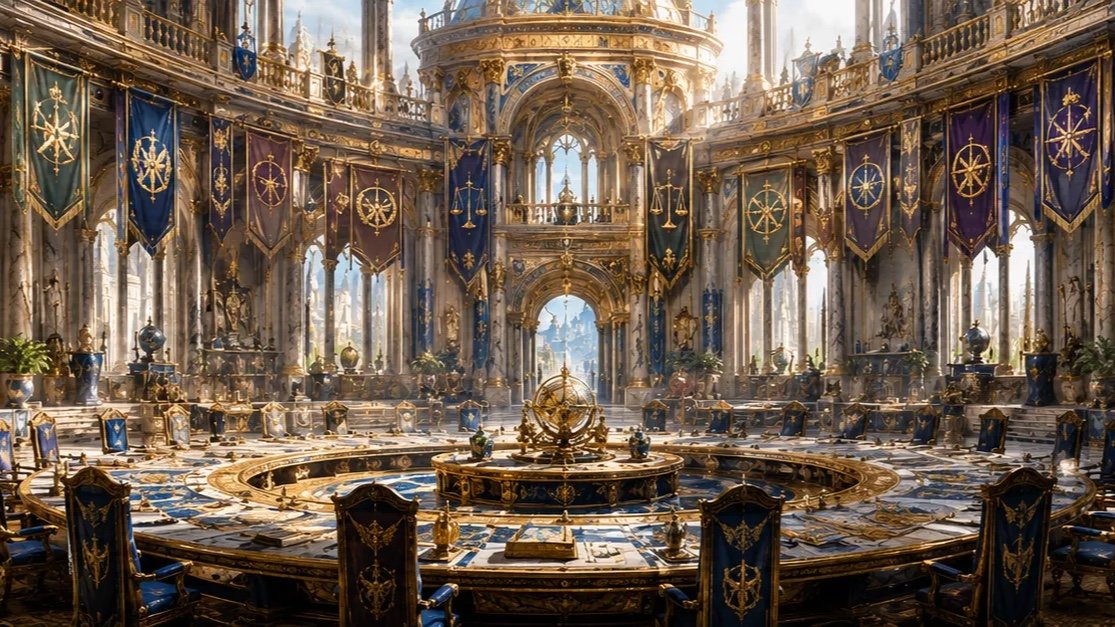
Representatives gathered beneath the banners of the Hall of Factions
Temporary archival illustration representing the many independent interests joined through the Trade Winds.

Faction Dossier

Formal Name
The Trade Winds Merchant Consortium
Common Names
The Trade Winds; the Consortium
Classification
Merchant Consortium / Chartered Civic Authority
Founded
More than two centuries ago
Origin
The Morgdhavian Archipelago
Geographic Reach
Khassid-wide, including a known presence in Gharnakthul
Governance
Independent merchant chapters operating under Consortium standards and charter
Crown Relationship
Independent of the Crown; formally chartered, regulated, and entrusted with public obligations within the Archipelago
Known Activities
Long-distance trade, brokerage, procurement, shared commercial infrastructure, arbitration, market oversight, and emergency commerce
Status
Active

A business bearing the Trade Winds mark remains independently owned. The mark signifies membership in the network, not ownership by the Consortium.

Overview

Independent in operation. Public in obligation.

For more than two centuries, the Trade Winds Merchant Consortium has connected merchants, craftspeople, caravan masters, importers, ship captains, warehouse keepers, and specialist dealers across the Morgdhavian Archipelago and far beyond its shores.

It began as a practical association of independent businesses. Members combined cargo space, shared trusted routes and warehouses, exchanged letters of introduction, recognized one another’s contracts, and used a growing web of commercial knowledge to obtain goods no local market could reliably supply.

The businesses remained their own. They still do. A smithy, general store, armorer, importer, or arcane dealer bearing the Trade Winds mark chooses its own wares, sets its own prices, and answers for its own dealings. What membership provides is access: to routes, suppliers, transport, credit, arbitration, information, and people who know where difficult things may be found.

As the network grew, the Crown recognized that it possessed something no ministry could readily reproduce: living knowledge of trade throughout the Archipelago. Rather than absorb the Consortium, the Crown granted it a civic charter. The Trade Winds remains independent, but within Morgdhavian jurisdiction it also carries public responsibilities for fair dealing, essential commerce, market stability, and the welfare of the population when private trade threatens public harm.

Consortium Record

A network that moves goods, recognizes obligations, and sells the whereabouts of the unfindable.

This record preserves the public account of the Consortium’s origins, chapter structure, commercial services, civic charter, limits of authority, and relationship with those who seek its knowledge.

Origins and Recognition

The Trade Winds began more than two centuries ago as a private association formed by merchants who understood that distance was easier to overcome together. Shared vessels and caravans lowered the cost of transport. Trusted warehouses allowed goods to move without their owners traveling beside them. Letters of introduction and recognized accounts made it possible to conduct business in unfamiliar ports. Information passed from chapter to chapter until the network knew not only what was moving through the markets of Khassid, but where shortages, opportunities, and dangers were likely to appear next.

In the Morgdhavian Archipelago, that knowledge became a matter of public consequence. Consortium records often revealed scarcity before Crown officials received formal reports. Its warehouses showed whether essential goods were truly absent or merely withheld. Its factors understood which routes had failed, which ports remained supplied, and where private conduct threatened the stability of whole communities.

The Crown did not create the Trade Winds and did not absorb it. It recognized an institution that had already become indispensable, granted it a civic charter, and placed its extraordinary authority under Crown regulation.

Chapters and Membership

A Trade Winds chapter is a local body composed of independent businesses. In a large city it may include smiths, armorers, weaponsmiths, jewelers, importers, general merchants, caravan operators, warehouse owners, alchemists, ship captains, and occasional dealers in arcane or exceptionally rare goods.

Prosperous chapters may maintain a hall, counting house, bonded warehouse, dockside office, auction room, or caravan yard. Smaller chapters may possess no common building at all. Their members meet where space and custom permit, and the businesses themselves constitute the chapter.

Membership does not erase local identity. Garran’s Forge remains Garran’s Forge; its proprietor does not become an employee of a distant company. The Consortium supplies connection, standards, mutual recognition, and access to shared systems. It does not turn its members into branches of a single shop.

The Trade Winds Mark

The small Trade Winds emblem displayed near a door, counter, warehouse gate, or trade stall carries a practical promise. It indicates that the merchant belongs to a wider network, can be found through that network, recognizes Consortium obligations, and may be held accountable through Consortium arbitration.

The mark does not promise generosity, low prices, or moral virtue. It promises commercial standing: the weights should be true, the agreed terms should be honored, and a member who abandons recognized debts or contracts risks losing access to the network that sustains their business.

Goods and Commercial Reach

The Consortium is most valuable where ordinary local trade becomes unreliable. Its members move foreign craftsmanship, rare materials, unusual arms and armor, fine textiles, costly dyes, exotic spices, specialist tools, alchemical ingredients, spell components, antiquities, luxury goods, and other wares whose origin lies far from the market in which they are sold.

Trade Winds members may also supply local shops that never join the Consortium. The network is not meant to replace everyday commerce. It gives independent businesses access to goods and suppliers that distance, danger, custom, or scarcity would otherwise place beyond their reach.

Finding the Unfindable

Information is among the Consortium’s most valuable commodities. A member may not carry the object a customer seeks, but may know which market occasionally receives one, which dealer last handled one, where an example was recorded, or who presently owns it.

For a finder’s fee or other agreed consideration, a member may make inquiries, identify a likely source, provide an introduction, or simply name the place or person from which the search should continue.

If it can be bought, someone in the Trade Winds knows where. They may even know who. And they’ll charge you for telling you. What you do with the information is your own business.

The fee purchases information, not success. The present owner may refuse to sell. The asking price may be impossible. The desired object may have changed hands, lie beyond lawful reach, or rest somewhere no sensible buyer would willingly go. The Consortium considers those to be separate difficulties.

Civic Authority within the Archipelago

Within the Morgdhavian Archipelago, the Trade Winds is a chartered civic authority: privately rooted, publicly responsible, independent in ordinary operation, and regulated by the Crown in the exercise of exceptional powers.

Its public obligations concern the relationship between merchants and the population. Under the terms of its charter, the Consortium may investigate manipulation of essential markets, audit relevant port or warehouse practices, coordinate emergency distribution, impose or administer crisis trade limits, and intervene where hoarding or artificial scarcity threatens the public welfare.

These responsibilities are one reason citizens often mistake the Trade Winds for a government office. Its decisions may carry legal weight, Crown officers may cooperate with its inquiries, and its actions may shape the availability of essential goods. Yet it remains neither ministry nor bureau.

Authority and Its Limits

The Consortium’s civic authority is neither universal nor unchecked. It applies within the Morgdhavian Archipelago, derives from a formal charter, and remains subject to Crown regulation. The Crown may define, review, or constrain the extraordinary powers recognized by that charter, but does not ordinarily direct the Consortium’s private commercial operations.

This arrangement produces a lasting tension. Members may resent obligations that place public stability above private advantage. Crown officials may dislike an authority they cannot command as they would a ministry. Citizens may demand intervention from an institution whose mandate is narrower than its reputation suggests. Consortium leaders, meanwhile, guard the distinction between recognition by the Crown and creation by it.

Beyond the Archipelago

The Trade Winds reaches throughout Khassid, including into Gharnakthul, but the Crown’s charter does not travel with it. Foreign chapters possess no Morgdhavian civic authority and must operate according to local law, treaty, custom, and tolerance.

Abroad, the Consortium functions much as it did before Crown recognition: as a network of independent merchants joined by commercial trust, shared standards, transport and storage arrangements, recognized accounts, and access to one another’s knowledge. Its influence rests on reputation and usefulness rather than Morgdhavian law.

Adventurers and the Consortium

Adventurers encounter the Trade Winds as customers, escorts, couriers, investigators, debtors, negotiators, and occasionally as the only people willing to recover merchandise from a route others have abandoned.

A chapter may arrange passage aboard a member vessel, hire protection for a caravan, seek the recovery of lost cargo, request an inquiry into a missing factor, or direct capable outsiders toward a seller whose terms require more than coin. Likewise, an adventuring company seeking a rare tool, relic, substance, or specialist soon learns to look for the Consortium mark.

The Trade Winds is a broker, not a fixer. It may tell a customer where a desired object lies and who claims it. The legality, diplomacy, danger, and wisdom of obtaining it remain the customer’s own business unless a second agreement says otherwise.

Archival Summary

The Trade Winds Merchant Consortium is not a chain of stores. It is a durable commercial network made powerful by the independence of its members and the reach of their relationships.

Within the Morgdhavian Archipelago, centuries of usefulness led to civic recognition and public obligation. Beyond it, the Consortium remains what it was at its beginning: merchants helping merchants cross distances, locate difficult goods, recognize trustworthy dealings, and sell valuable knowledge to anyone prepared to meet the fee.

Consortium Directory

Member Establishments

These independent businesses bear the Trade Winds mark. Search the directory by name, service, specialty, proprietor, or tag, or narrow the records by place and establishment type.

Loading member establishments…