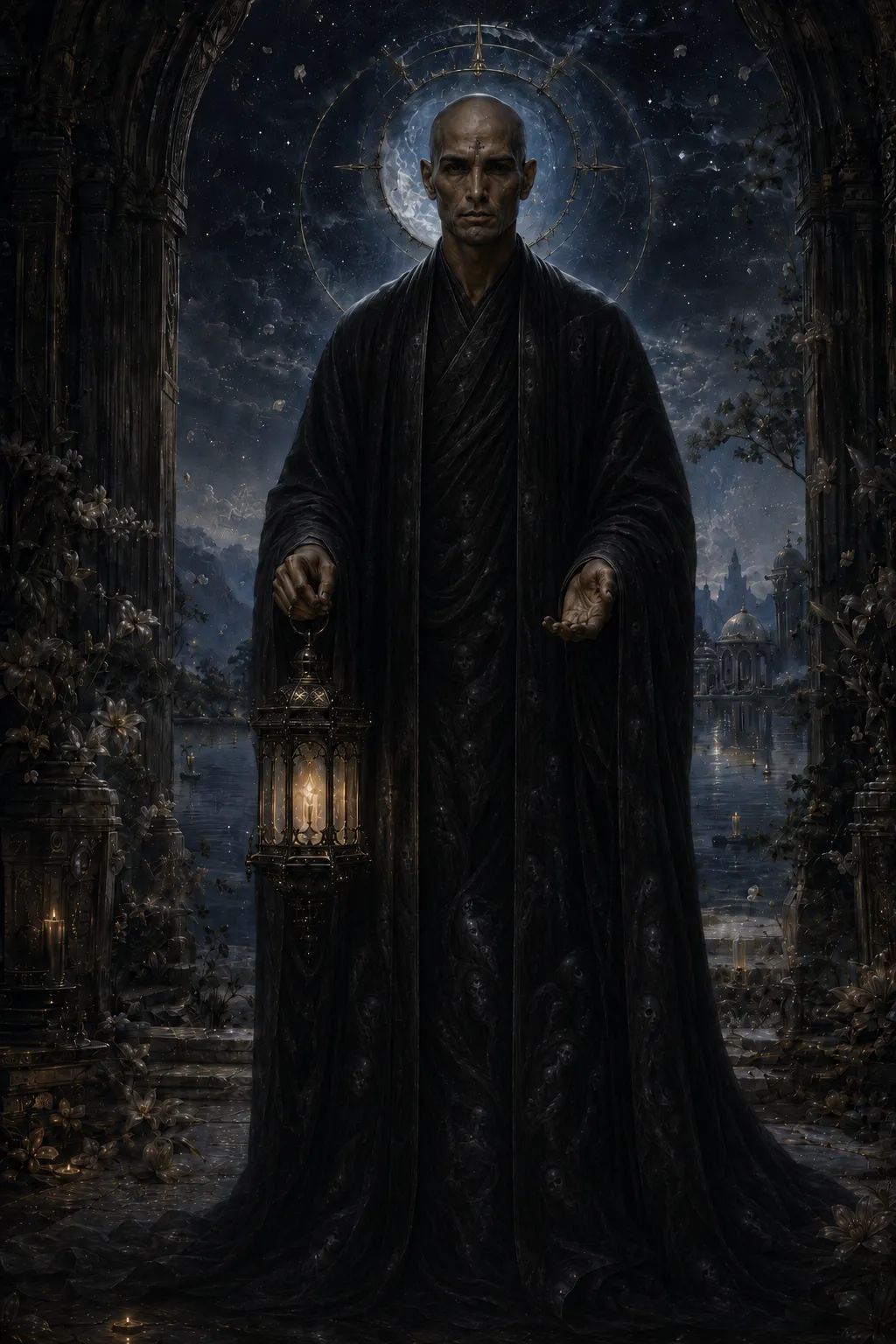
Luzion shares a close and unusually peaceful affinity with Naelis, whose concern with life approaches the same threshold from the opposite direction. Naelis preserves and restores while recovery remains possible; Luzion receives what can no longer be restored without turning preservation into another burden. Their clergy frequently work beside one another, and neither tradition treats the appearance of the other as evidence that its own work has failed.
Illario stands near Luzion in a different way. Luzion releases the person from mortal obligation, while Illario preserves the record of what that person did, suffered, changed, or left behind. The two concerns meet wherever remembrance must remain accurate without becoming possession.
Isilkarion shares Luzion’s concern with the dead but directs greater attention toward the continued safety of the soul after severance and its protection from loss, corruption, or oblivion. Their jurisdictions overlap sufficiently to produce cooperation but remain distinct enough that neither priesthood treats the gods as interchangeable.
His relationship with Vargesi is considerably more difficult. Luzion governs completion and protects the passage of souls, including those who die without another divine patron. Vargesi’s dominion over undead creatures places her repeatedly at the boundary Luzion is charged to safeguard, particularly where an unclaimed soul or body might otherwise appear available to any power willing to seize it. Luzionite doctrine rejects that assumption completely — the godless dead are not ownerless. Even so, their relationship is not one of uncomplicated hatred; there have been circumstances in which Vargesi has imposed order upon forms of undeath that already existed rather than creating them, and Luzion recognizes the difference between containment and violation. Their tension arises from the far more fundamental disagreement over when a completed mortal life may properly be made to continue.
Ssthax draws another form of opposition by making sickness, decay, famine, and prolonged survival into instruments of leverage. Luzion does not object to survival, but he opposes the deliberate preservation of suffering when continued life has become useful principally to the one inflicting it.
Kieron generally aligns with him where lawful execution, battlefield dead, prisoners, and the respectful treatment of remains are concerned. Luzion nevertheless rejects the argument that legality alone makes a death just; a sentence may be lawful and still be wrongly imposed, and death does not relieve those who ordered it of responsibility.
His relationship with Morgdhav is especially visible among maritime peoples. Morgdhav may govern the sea that takes a life, while Luzion governs the passage that follows. Rites for the drowned commonly acknowledge both without treating either as subordinate to the other.
Z’hani produces in Luzion an unease rarely observed in his dealings with other powers. The cause appears connected to Z’hani’s prophetic sight, which reaches into possibilities beyond even divine certainty. Luzion does not treat him as an enemy and appears to trust both his judgment and restraint, yet Z’hani’s presence unsettles the otherwise firm confidence with which Luzion approaches death and passage. Neither deity has offered a fuller explanation.
Luzion has few rivalries rooted in pride, competition, or status. His strongest tensions arise wherever death is treated as an opportunity for possession rather than completion, particularly when another power assumes that what has been released from mortal life has thereby become available for use.